Table of Contents
Choosing the best glue for wood depends on what you are repairing, the type of wood you are using and how strong the finished bond needs to be. Some adhesives are ideal for joining wooden boards, while others work better for small repairs, filling gaps or bonding wood to different materials.
Using the wrong adhesive can lead to weak joints, messy finishes and repairs that do not last. The right choice can help you achieve a reliable bond for furniture repairs, woodworking, crafts and everyday DIY projects.
In this guide, we explain the different types of wood adhesives, where each one works best and what to consider before choosing a product.
What Is the Best Glue for Wood?
For many ordinary woodworking projects, wood glue designed for the specific application is a good starting point. It is commonly used to join compatible wooden surfaces, including furniture components, wooden boards and craft projects.
However, wood glue is not always the best option. Super glue may be suitable for small, precise repairs, while epoxy can be useful for certain repairs that require gap filling or bonding different materials.
The best choice depends on the project.
Types of Glue for Wood and Their Uses
Different adhesives have different strengths, setting times and application requirements. Understanding these differences makes it easier to choose the right product.
1. Wood Glue
Wood glue is designed for bonding wood to wood. Depending on the formulation, it can be suitable for furniture assembly, woodworking, joinery and general DIY repairs.
Best for:
- Joining wooden boards
- Furniture assembly and repairs
- Wooden crafts
- Indoor woodworking projects
Advantages:
- Designed for compatible wood surfaces
- Easy to apply for many common projects
- Suitable for a wide range of woodworking tasks
Things to consider:
Wood glue generally performs best when the surfaces fit together properly and are clean. Follow the product instructions for application, clamping and curing time. Not every wood glue is suitable for outdoor use or prolonged moisture exposure.
2. Super Glue
Super glue, also known as cyanoacrylate adhesive, is designed for rapid bonding. It can be useful for small wooden components, minor repairs and precise applications where a fast-setting adhesive is appropriate.
Best for:
- Small wooden objects
- Minor decorative repairs
- Small components that fit closely together
- Certain craft projects
Advantages:
- Fast bonding for many applications
- Useful for small, precise repairs
- Often requires only a small amount of adhesive
Things to consider:
Super glue is not automatically the best choice for large wooden joints or structural furniture repairs. Its suitability depends on the wood, joint design and product specifications. Always check the manufacturer’s instructions.
3. Epoxy Adhesive
Epoxy adhesives typically consist of two components that must be mixed before use. Depending on the formulation, epoxy can offer strong bonding and may be suitable for certain repairs involving wood and other materials.
Best for:
- Selected furniture repairs
- Bonding wood to compatible materials
- Certain damaged wooden components
- Repairs where the product is specifically suitable for the gap or joint
Advantages:
- Available in formulations for different applications
- Some products can fill small gaps
- Can bond a range of compatible materials
Things to consider:
Mixing ratios, working time, curing time and surface preparation are important. Not every epoxy is suitable for every wooden repair, and adhesive should not replace proper mechanical support where a joint must carry significant loads.
4. Grab Adhesive
Grab adhesive is used in some installation and construction applications where materials need to be bonded in place. Certain formulations are suitable for wood, but the intended materials and application must be checked on the product label.
Best for:
- Suitable installation work
- Bonding compatible building materials
- Selected trim and panel applications
Advantages:
- Available in formulations for different construction applications
- Useful for certain installation tasks
- Some products are designed to reduce the need for immediate support
Things to consider:
Grab adhesive is not interchangeable with woodworking glue. Check whether the product is suitable for the materials, the joint and the conditions in which it will be used.
Wood Glue vs Super Glue vs Epoxy
Use this comparison to narrow down your options.
| Feature | Wood Glue | Super Glue | Epoxy Adhesive |
|---|---|---|---|
| Main use | Wood-to-wood joints | Small, precise repairs | Selected repairs and mixed-material bonding |
| Setting time | Varies by formulation | Often very fast | Varies by formulation |
| Surface fit | Usually best with close-fitting joints | Often suited to close-fitting surfaces | Some products can fill small gaps |
| Large woodworking joints | Often suitable when specified | Generally not the first choice | Depends on the joint and product |
| Best starting point | Furniture and woodworking | Small components | Repairs requiring a suitable two-part adhesive |
Always follow the technical instructions for the specific adhesive. Setting time and full curing time are different, and neither should be assumed from the adhesive category alone.
How to Choose the Best Glue for Your Wood Project
Before buying an adhesive, consider these factors.
1. Identify the Type of Repair
A loose wooden joint, a broken decorative ornament and a wooden panel being attached to another material are different jobs.
For a conventional wood-to-wood joint, start by checking suitable wood glue products. For a tiny repair, a compatible super glue may be appropriate. For certain mixed-material repairs or small gaps, consider an epoxy specifically designed for the application.
2. Check Whether the Wood Is Finished
Paint, varnish, wax and oil can affect adhesion. If you are repairing furniture, determine whether the adhesive is compatible with the finish and whether the surfaces need to be prepared.
For many bonding applications, clean surfaces provide a better starting point than surfaces covered in dust or loose material.
3. Consider Indoor or Outdoor Use
Not all adhesives tolerate moisture, temperature changes or outdoor conditions equally well.
For outdoor furniture or garden projects, check the product’s stated weather resistance and suitability for the intended exposure. Do not assume that an adhesive is waterproof simply because it forms a strong bond.
4. Look at the Gap Between Surfaces
Many woodworking adhesives perform best when the wooden components fit together closely. If the joint has a significant gap, choose a product specifically designed for that situation or repair the fit before bonding.
An adhesive should not be used to compensate for a badly designed or unsafe structural joint.
5. Check Setting and Curing Times
Some adhesives set quickly, while others require clamping or support for longer. Full curing may take longer than the initial setting period.
Read the label before starting so you can allow sufficient time for the joint to remain undisturbed.
How to Apply Glue to Wood Correctly
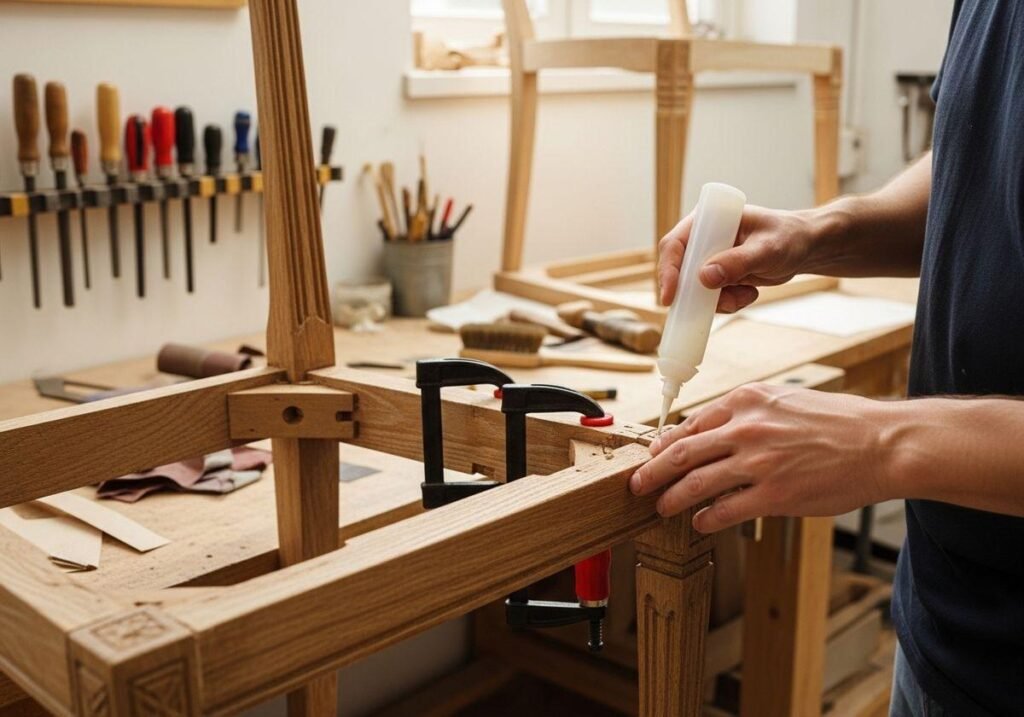
Even a suitable adhesive can produce a poor result if it is applied incorrectly.
Follow these general steps, adapting them to the product instructions.
- Prepare the surfaces. Remove dust, dirt, loose material and any incompatible coatings.
- Check the fit. Make sure the wooden components meet as intended before applying adhesive.
- Apply the recommended amount. Too much glue can create excess squeeze-out, while too little may leave areas without adequate contact.
- Join the pieces. Position the components carefully before the adhesive sets.
- Clamp or support if required. Follow the manufacturer’s recommendations for pressure and holding time.
- Allow sufficient curing time. Do not load, move or stress the joint before the adhesive has cured as directed.
- Clean up safely. Remove excess adhesive using the method recommended for the particular product and surface.
For load-bearing furniture, structural joinery or repairs where failure could cause injury, use an appropriate repair method rather than relying on adhesive alone.
Common Mistakes When Gluing Wood
Using the Wrong Adhesive
A product designed for small, close-fitting repairs may not be suitable for a large joint. Check the intended application before use.
Skipping Surface Preparation
Dust, grease and incompatible finishes can interfere with bonding. Prepare the surfaces as directed by the manufacturer.
Applying Too Much Glue
Excess adhesive can create a messy finish and may not improve bond strength. Follow the recommended application instructions.
Moving the Joint Too Soon
An adhesive may feel set before it has reached its specified full cure. Allow the joint to remain supported for the recommended period.
Ignoring Moisture Resistance
Indoor and outdoor projects can have different requirements. Choose a product suitable for the expected conditions.
Frequently Asked Questions
What is the strongest glue for wood?
There is no single strongest glue for every wooden project. The result depends on the adhesive formulation, wood species, joint design, surface preparation and curing conditions. A suitable wood glue is often a good starting point for conventional wood-to-wood joints.
Is super glue good for wood?
Super glue can work well for certain small wooden repairs and closely fitting components. It is not automatically the best choice for large joints, furniture assembly or structural applications.
Is epoxy better than wood glue?
Not necessarily. Wood glue is commonly used for conventional wood-to-wood joints, while selected epoxy formulations may be useful for certain repairs, gaps or mixed-material bonds. Choose according to the application rather than assuming one adhesive is always better.
Can I use wood glue on painted wood?
Paint can interfere with bonding, so the result depends on the adhesive and the condition of the finish. Check the product instructions and prepare the surface as recommended.
How long does wood glue take to dry?
Drying, initial setting and full curing are different stages. Timing varies by formulation, temperature, humidity, wood type and joint conditions. Follow the manufacturer’s stated clamping and curing times.
Can wood glue be used outdoors?
Some wood glues are designed for outdoor exposure, while others are intended for interior use. Check the product’s moisture-resistance rating and suitability for the conditions before using it outdoors.
Final Thoughts
The best glue for wood depends on the job you need to complete. Wood glue is often a practical starting point for conventional woodworking and furniture joints. Super glue may suit small, precise repairs, while a suitable epoxy can help with selected repairs involving gaps or different materials.
Before choosing an adhesive, consider the type of wood, the surface finish, the size of the joint and the conditions the finished repair will face. Correct preparation and sufficient curing time are just as important as choosing the right product.
Explore the Prostik Adhesives range to find an adhesive suited to your next DIY, woodworking or repair project.